Beijing - China's Seat of Power
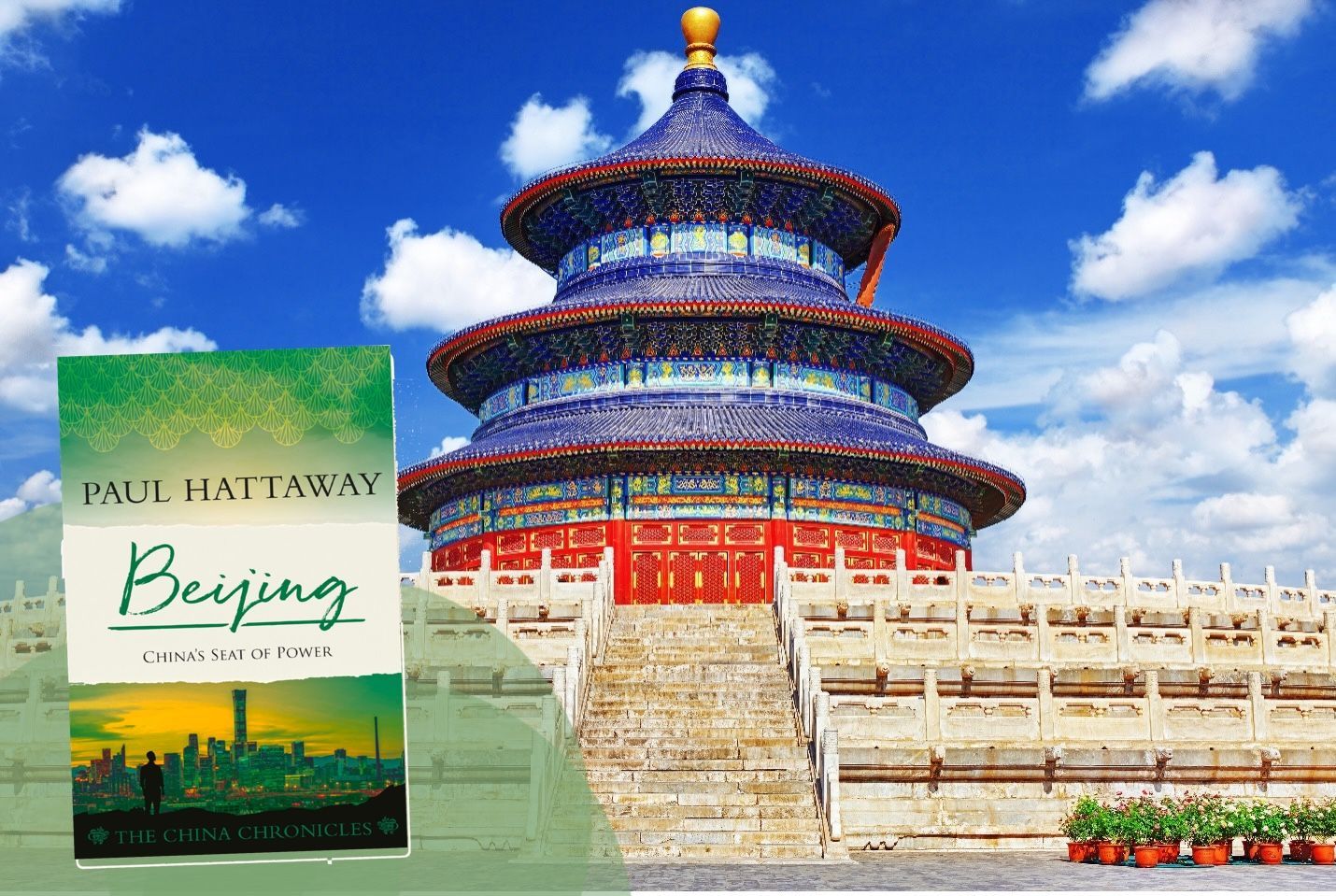
The Temple of Heaven in Beijing is the only temple in China without a single idol. It was here that for centuries China’s emperors humbly offered annual sacrifices to the Creator God in ceremonies that closely mirrored Old Testament rituals.
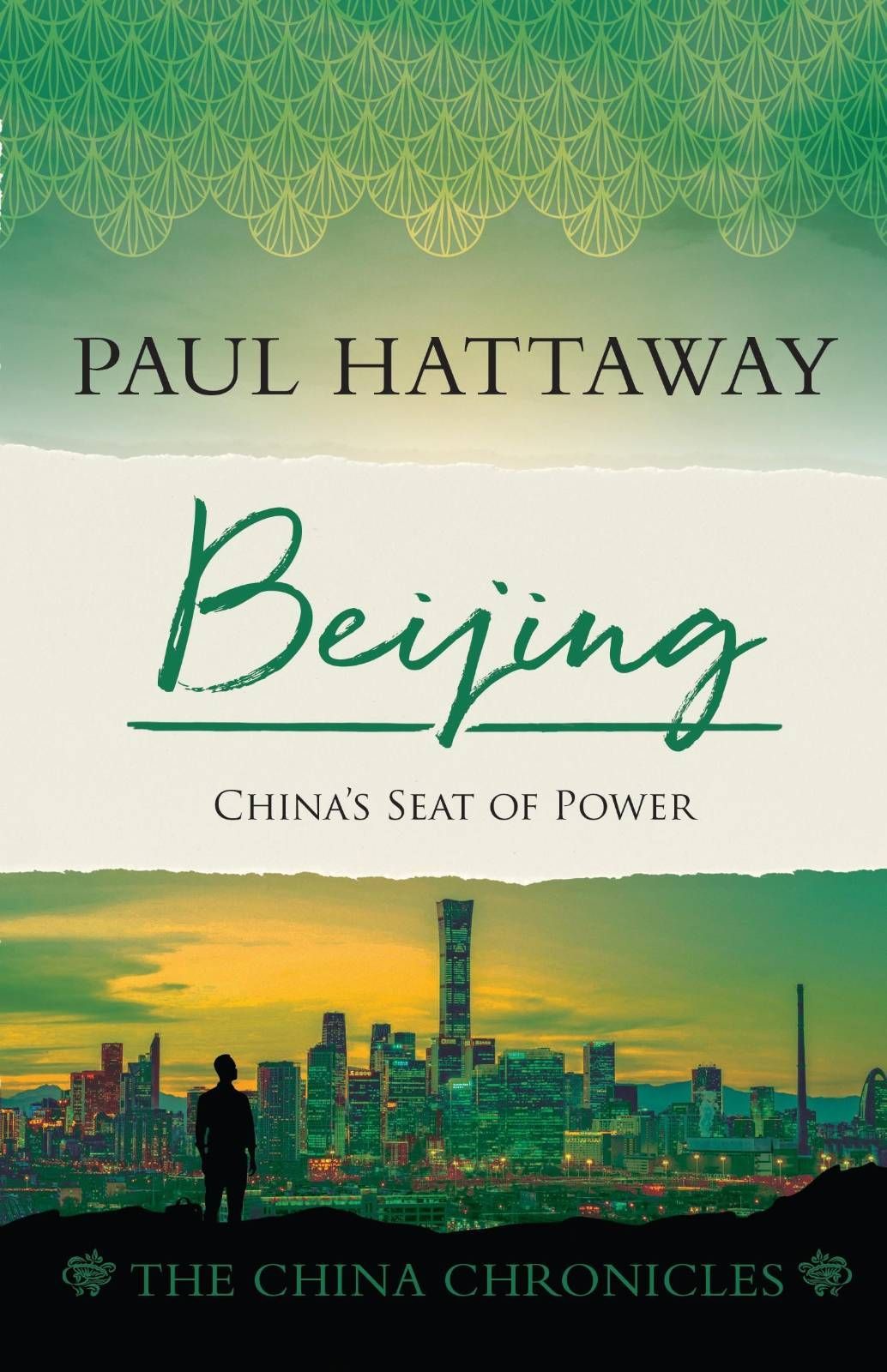
A New Book by Paul Hattaway
In this newsletter, we are pleased to announce the eighth book in our series on the mighty revival that has swept China during the past 50 years.
The China Chronicles are proving to be a great encouragement and are enriching the lives of those who read them. Beijing has served as the capital of China more than 600 years.
Home to 22 million people, Beijing has emerged from a mundane frontier town to become one of the world’s great cities—the abode of emperors and presidents, and the place from which all key decisions concerning the activities of the Middle Kingdom emanate.
Beijing was home to a succession of famous Catholic missionaries including Matteo Ricci and Adam Schall, who sought to convert the emperor of the time. They came close to succeeding.
The city later became home to many key Chinese church leaders including Wang Mingdao and Allen Yuan, and today several bold house church leaders continue to stand for the truth of the Gospel in the face of severe persecution.
The remainder of this newsletter is an excerpt from the life of Wang Mingdao in ‘BEIJING: China’s Seat of Power.”
To order a copy of the book, you can purchase it here.
Also a Kindle (e-book) version is also available online.
Alternatively, if you send a donation to any Asia Harvest project, please indicate you would like a complimentary copy of the book, and we will gladly send you one.
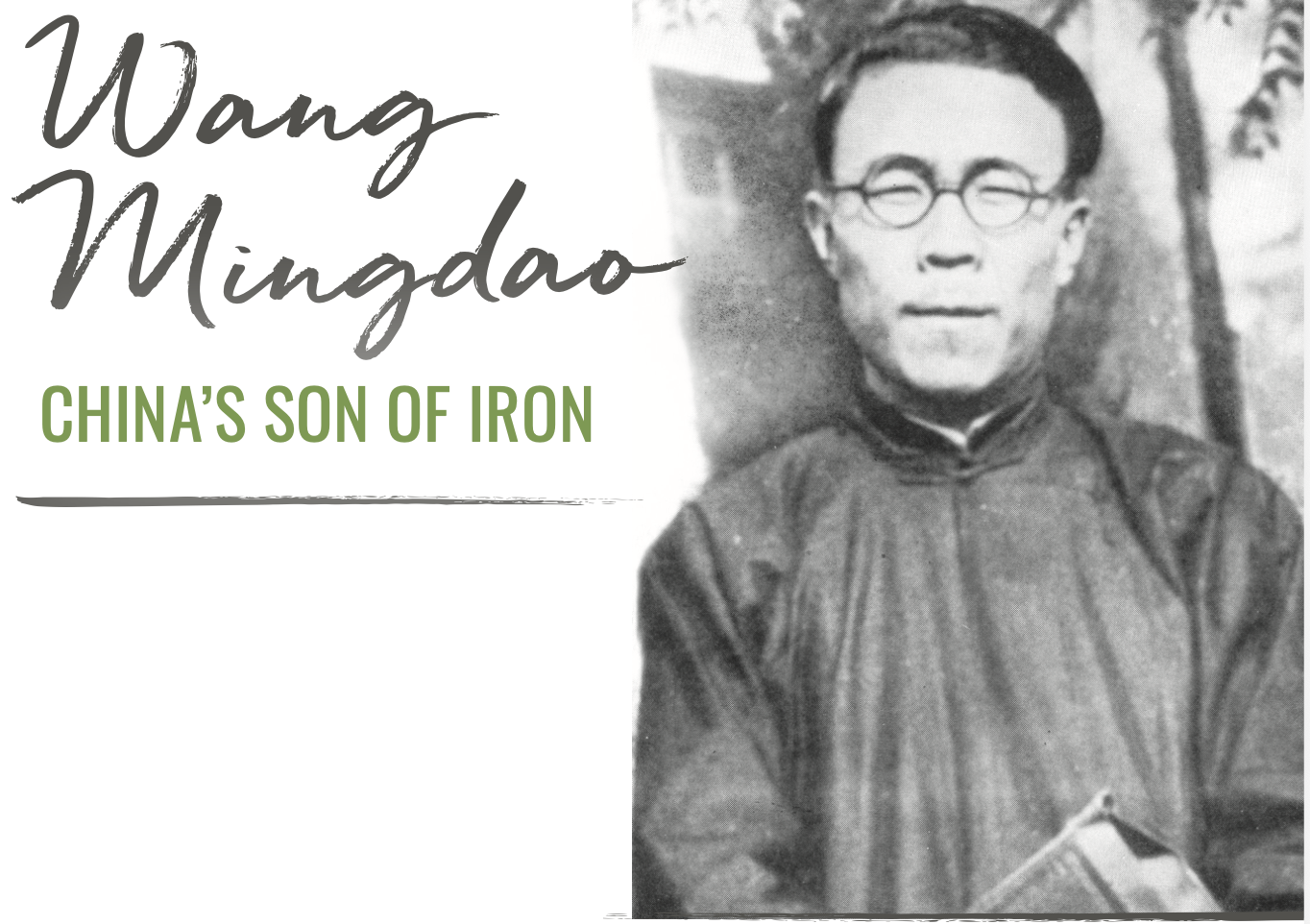
Born in 1900 as tens of thousands of Chinese Christians and missionaries in China were massacred for their faith in Jesus, Wang Mindao grew up to become one of the greatest ever Chinese Christians.
He is remembered as “The Patriarch of the House Churches“ by millions of believers in China today.
His example of faith and unwavering courage created a template for future generations of persecuted house church Christians to follow.
Wang‘s grandmother named him Tiezi (“Son of Iron“)—a nickname that remained with him for the rest of his life. Even at a young age, the boy’s character began to reflect his name. At primary school he was often involved in fights as he stood up for what was right.
On one occasion, some of the older students decided to bully the younger ones by making them shave their heads. Wang refused to comply and said:
“Whoever dares to do it, I will take the scissors and stab out his eyes.”
No one made a move, and his hair was preserved intact.
God’s Secret Bible School
In his teenage years Wang understood more of the Bible, and he saw that many of the missionaries‘ traditions and practices did not line up with the Gospels. He confronted the missionaries about many things, much to their annoyance. At the age of 20 he surrendered his heart to the Lord. It was said that
“Peace flooded his soul, and he knew he would never be the same again. As a boy, he had been baptized by sprinkling in the Methodist church, but the Scriptures convinced him that the experience was unbiblical and that, as a new creation in Christ, he needed to be baptized by immersion.
Both the Methodist and Presbyterian leaders warned that if he took a stand by being baptized by immersion, he would be expelled from their school, and any chance of a university education would be ruined.
Wang stood firm, saying he was willing to sacrifice himself for the truth, and he was expelled. He and five other students declared their support for his stance and also commited to being baptized by immersion.
One of them, Shi Tianmin, followed Wang’s example and stood for truth. Wang and Shi continued to serve the kingdom of God together for the next 29 years.“
Two days later, as they trudged through the snow to the moat surrounding Beijing, they reached a bridge where a waterfall had created a small pool and decided to be baptized there.
As Wang was lifted out of the water, his long hair turned into thin icicles and his baptismal garments froze hard and solid like thin boards.
As he marvelled at the grace of God and the changes in his life that Jesus Christ had brought about, Wang decided to adopt a new given name, Mingdao, which means “understanding the Word.” He immediately retreated to Beijing’s Western Hills, where he read the Bible through six times in the next 62 days.
Wang’s mother was furious when she discovered that her son had been expelled from school and had no job or prospects. She had hoped he would take care of her in her senior years. Wang’s elder sister and aunt also railed against him, claiming he was mentally unstable and good for nothing.
After an unsuccessful search for work, Wang had a lot of spare time on his hands, so he turned the small garden shed on the side of his mother’s house into a study. In that little room, which he dubbed “God’s Bible School,” he met daily with the King of Kings, and the beginning of one of the great ministries in the history of the Chinese Church was born.
At the age of 23, Wang Mingdao emerged from his private Bible school and began his public ministry. He led a fellowship in his home in Beijing that started with a dozen friends, but soon a new building was needed to accommodate the hundreds of people who attended the four services each week.
A hall was rented that could seat 200 people, with another 100 able to listen from the courtyard.
In his sermons, Wang focused on doctrinal purity and did not hesitate to expose erroneous doctrines and teachers from the pulpit. He also steadfastly spoke against Christians being involved in politics, believing the Church must be separate from all political involvement.
After marrying a preacher’s daughter, Liu JIngwen in 1926, they experienced a happy marriage and successful ministry together. Their Beijing fellowship grew, and by 1936 they had saved enough money to buy some land and build the Christian Tabernacle, which could seat 800 people. It was regularly filled to overflowing several times per week and was the largest congregation in the capital.
Wang was determined to keep church life simple in a bid to avoid the many Western cultural and non-biblical traditions that missionaries had introduced to the Chinese Church.
He refused to be called “pastor” or any other religious title, and the church had no salaried workers, including himself. Offerings were never collected. Rather, a box was placed outside the main worship room where believers could give anonymously if they wished, and the church never lacked for any resources.
Wang was also wary of false conversions and refused to allow anyone to be baptized until they had displayed clear fruits of repentance. As a result, a very high percentage of people who met Christ at the Christian Tabernacle remained true in their commitment to Jesus.
The Red Dragon
Mao Zedong and the Communist Party gained control over Beijing in January 1949, and by the early 1950s they had created the Three-Self Patriotic Movement—a state-approved organization to control Christianity. Great pressure was placed on church leaders throughout the country to join their congregations to the TSPM, and thousands did.
Wang Mingdao, however, knew that submitting to an atheistic institution was akin to denying Christ, so from the beginning he strongly opposed the TSPM both from the pulpit and in his magazines.
Being the leader of the largest church in Beijing, the government knew that Wang Mingdao had to be convinced to submit. Years of intense struggle followed as the Red Dragon used its political might in a bid to crush the pastor’s iron will.
In 1954, the pressure for Wang to join the Three-Self Church reached fever-pitch, but he refused to bow his knee to them. Senior Chinese church leaders came to his home to try to convince him to join, and a public announcement was made that all Christians in Beijing should attend a public meeting denouncing Wang Mingdao.
Vile accusations and threats were issued against Wang, but he stood silent, faced the crowd, and refused to say a word. Normally, crowds at such meetings were whipped into an emotional frenzy, but on this occasion the audience was silent, and some wept openly.
After being sent home, Wang issued a statement of his position against the Three-Self Church, which has gone down as a pivotal moment In Chinese church history. Wang’s statement not only set the course for the rest of his life, but it could be said to have spurred the birth of the house church movements, which today comprise tens of millions of Christians throughout China. He declared:
“It is lamentable that many Christian leaders use the principle of obedience to man’s rules and submission to man’s authority to cover up their cowardice and failure. They thus deceive many believers who don’t fully understand the truths of the Bible.
This results in the faith of the Church and the ministry being subordinated to the rule of men and men’s authority. The truth then becomes obscured, the Bible misinterpreted, the foundations of the Church undermined, and the flock scattered.
The Church and the gospel of Christ are thereby degraded and put on a lower plane than compliance to men’s rules and submitting to human authority. These foundations and precious things are so lightly surrendered by some so-called servants of God!
How can such Christian leaders escape the wrath of God?”
On August 7, 1955, Wang Mingdao delivered what would be his final sermon for many years, which he entitled, “The Son of Man is betrayed into the hands of sinners.” Eight hundred believers packed the Christian Tabernacle. Later that night, Wang was at home reading some letters when Jingwen thought she heard a sound outside and went to investigate. She did not return to the room, for she had been quietly arrested and bundled into a police car.
Suddenly, as Wang continued to read his mail, he heard a loud command:
“Don’t move!”
He turned around to find two armed officers in his room, with their guns pointed at him. He was handcuffed, driven away, and locked in a cell, and for months his interrogators tried to systematically break him down physically and mentally. In April 1956, he was charged with ten “crimes,” including that he had opposed the Three-Self Patriotic Movement.
An Amended Confession
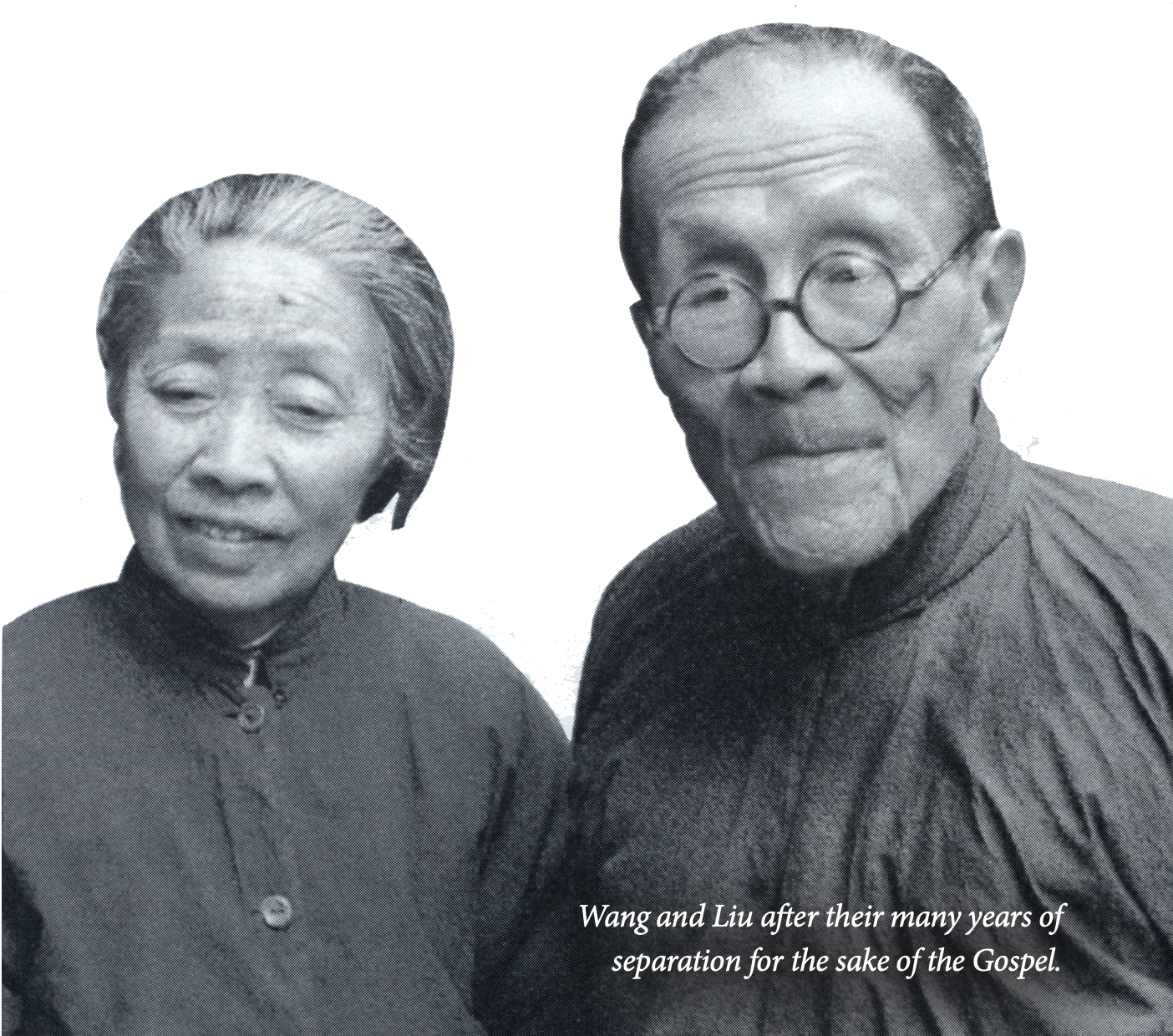
Wang and Liu after their many years of separation for the sake of the Gospel.
By September 1956, more than a year had passed since the arrests of Wang and Liu. Wang agreed to sign a confession of the ten points the government had accused him of, as he didn’t think any of them compromised his faith. After signing the confession, Wang was allowed to return home, where he found his beloved wife Liu Jingwen waiting for him.
In the days following his release, the government publicly announced that Wang Mingdao had seen the error of his ways and had been reformed by the Communist Party. Shaken by the realization that he had been tricked and misrepresented, and concerned about the impact the false news would have on God’s people throughout China, Wang fell into a deep depression.
His soul was tormented, and he may have suffered a nervous breakdown. He was heard to continually mutter, “I am a Judas,” and Jingwen feared that Wang might succumb to the darkness by taking his own life.
After a while, Wang was again summoned to the police station. Liu was alarmed and feared that this time he would be executed. A few days later, however, she was shocked when her husband walked through the front door! He seemed none the worse for the experience, and she eagerly wanted to know what had happened.
He explained that after being interrogated, the officers had tried to get him to renounce Christ.
“That is completely out of the question,” he replied. “I will never deny my Lord and Savior. The Bible says if I deny Him, then He will deny me before God.”
Seeing that he would not budge, the interrogators tried a new tactic. Cunningly, they asked Wang if the Bible specifically prohibited denying heaven. “If you are willing to write a confession saying that you deny the existence of heaven, we will not trouble you anymore and you will be free to go home to your wife.”
In his weakened state, and overwhelmed with fear, Wang could not think of any Bible verse that specifically prohibited a Christian from denying heaven. He agreed to write and sign the statement.
The officers were thrilled at their success. They knew their superiors would be overjoyed, and news would quickly spread throughout the country that China’s “iron son” no longer believed in heaven.
Wang sheepishly told Liu that he had signed a statement agreeing to “one or two non-essential things.” Liu felt uncomfortable and demanded to know the full story. Wang told her the truth, hoping that his loving wife would understand and accept his decision.
Instead, the moment Liu heard what Wang had done, her face turned red with fury. She grabbed Wang by the arm and pushed him toward the front door of their home. “Get out!” she screamed. “I don’t want to live with a man who doesn’t believe in heaven!”
Wang Mingdao was devastated. Whatever level of wrath the Communist Party had deployed against him was no match for the wrath of his wife. He realized that he had compromised, and he knew there was only one thing he could do to repent.
He made his way back to the police headquarters, where the officers were surprised to see him so soon after his release. “I would like to amend my statement,” Wang said. Thinking he had more to add to his confession, the officers quickly brought his statement and a pencil, and told him he should confess as many of his crimes as possible.
The moment the paper was placed in front of him, however, Wang tore it into small pieces and quickly stuffed them into his mouth. He manged to swallow some of the fragments, while the others were reduced to a soggy pulp.
He had amended his confession.
The authorities were enraged, and he was dragged away and beaten. He was not sentenced immediately, but now the government knew that Wang would no longer compromise his faith. A line in the sand had been drawn, and the Communist Party began to create a severe case against Wang Mingdao that would make a spectacle of him and send shockwaves through the Body of Christ.

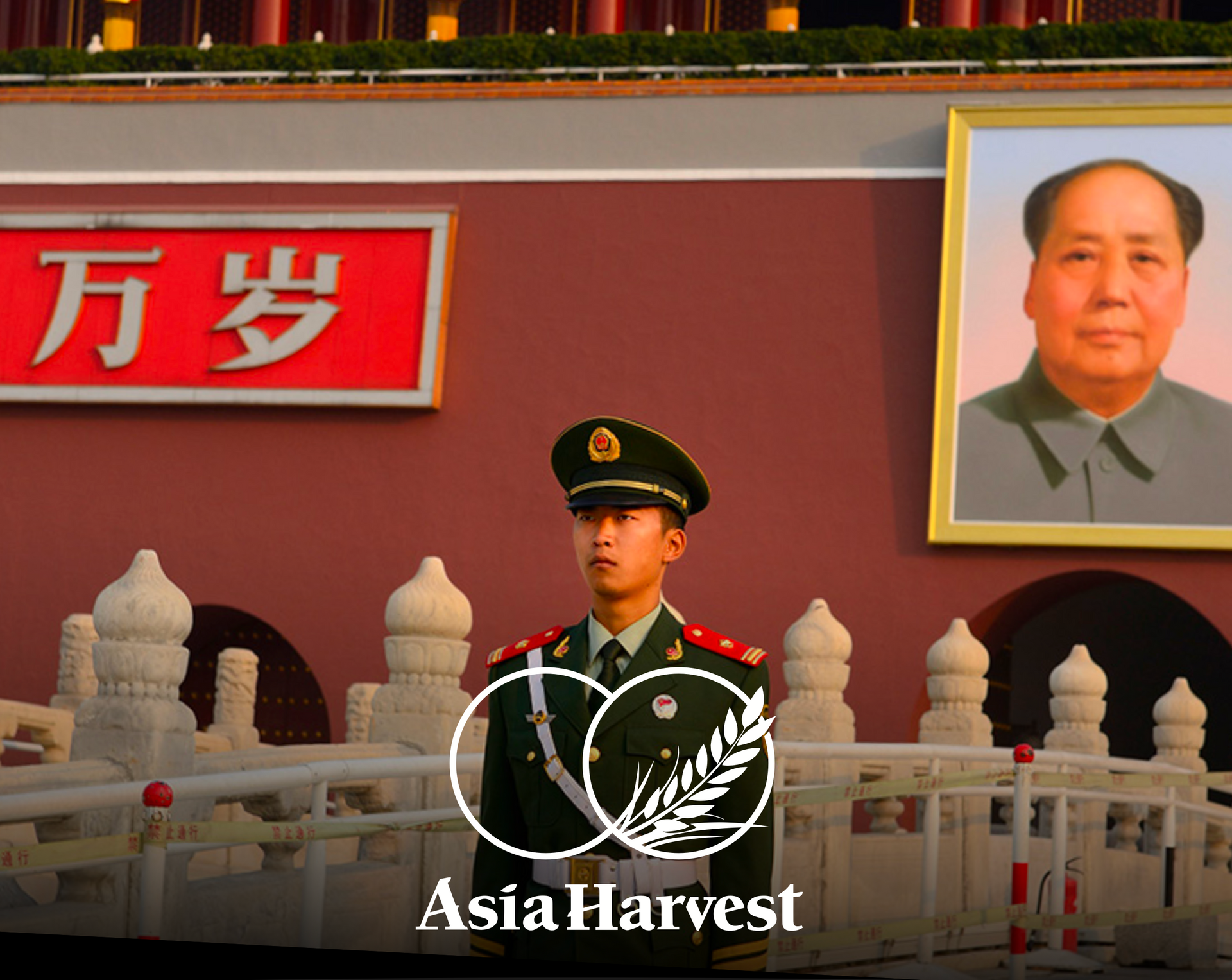
BELOW: The Gate of Heavenly Peace in Beijing. For countless generations China’s rulers issued decrees from this spot, dispatching their written orders throughout the empire.
The emperors were believed to be God’s authorized representatives on the earth. The Communists took advantage of this deeply-grained belief by making the Gate the centerpiece of their rule.
E-Newsletter Sign Up

RECENT POSTS


"Feel free to share this message with interested Christians or on social media" - Asia Harvest