Nagaland, India
When Heaven Came Down
(Part 2)
In April 1959, a well-known
Indian Army Officer, Major Thomas, decided to completely annihilate all the
people living in Sendenyu village, a Rengma Naga village near Tseminyu. This
village had gained the wrath of the Indians because it had been one of the first
villages to hoist the flag of the Independent Republic of Nagaland, and the
villagers were known to be active in helping the Naga armies who were hiding out
in the mountains. Two days’ prior to the arrival of Major Thomas and his men,
the occupants of Sendenyu were alerted to his diabolical plans to wipe out the
people and destroy the village to ashes. The trembling villagers gathered in the
church and prayed to the Merciful God for deliverance from the cruel hand of the
devil. The Holy Spirit spoke through various members of the congregation and
instructed the people on how to receive Major Thomas. The Lord told them not to
be afraid because He was with them. They were to receive the Major at the
village gate, on the eastern side, by singing a hymn entitled ‘Let Him In’.
Let us continue the story in the
words of eyewitnesses of that day.... “They were to stand in a row, with the
Pastor in the front, followed by the little children, then the young girls and
women folks and so on. Upon his arrival, everyone should greet him by shaking
hands with him, all the while singing the proposed hymn as they escort him to
the church. It was further instructed that once they reached the doorstep of the
church the Major’s shoes should be removed and his feet washed. Then he must be
made to sit at the pulpit next to the Pastor, and time allotted for him to give
a speech....
Before reaching the village, the
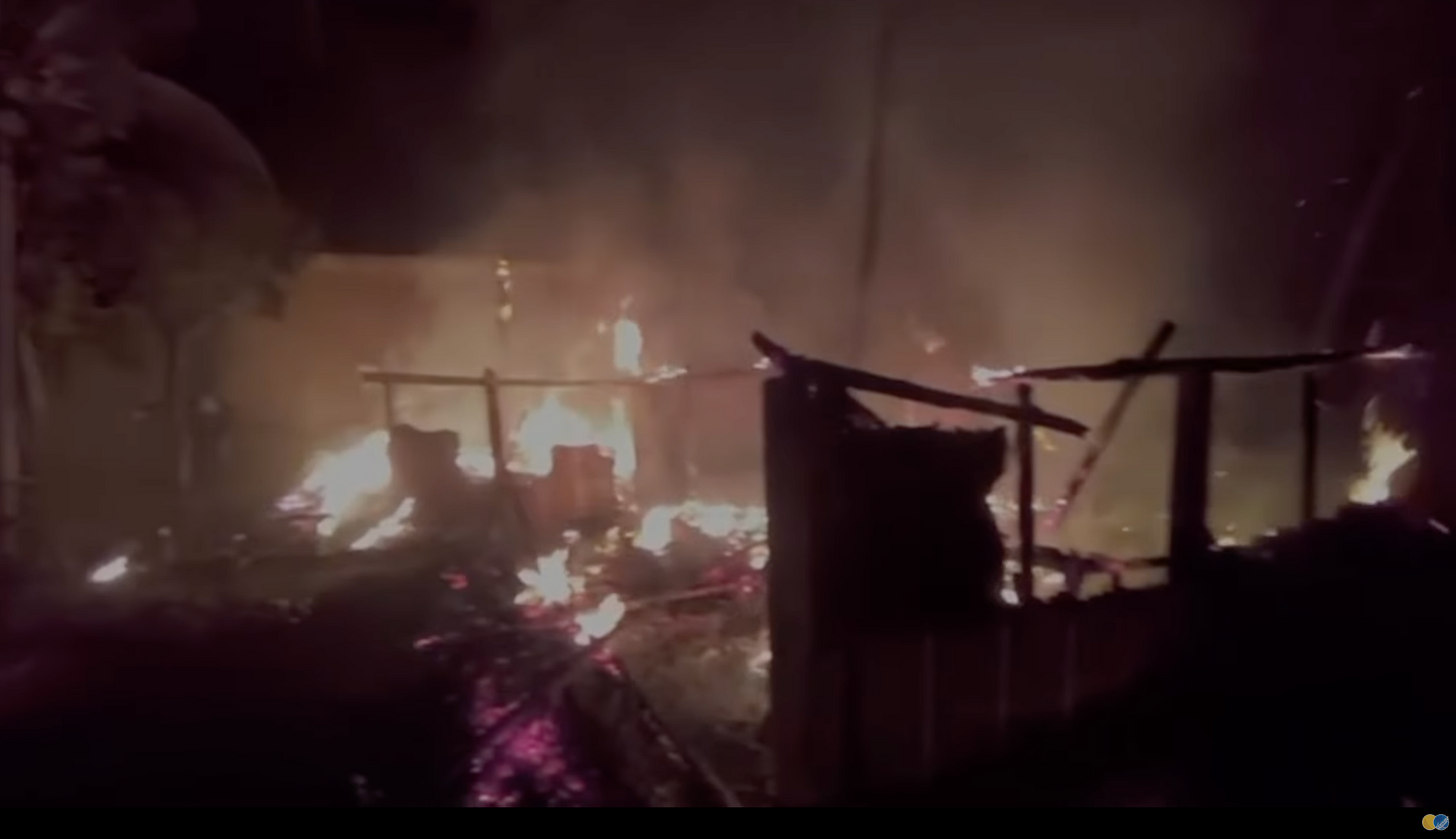
Major and his troops burned the shacks in the fields that lay on his way. This
terrified the villagers, but the Lord God reminded them not to be afraid because
He was with them. Upon his arrival at the reception gate at the village
entrance, the Pastor, children and everyone in the row greeted him by shaking
his hands, singing songs, and escorted him to the church. At the church
entrance, the believers took off the Major’s shoes, washed his feet and made him
sit with the Pastor at the pulpit. The congregation prayed for him and gave him
time to deliver a speech to them.
Major Thomas then stood up in
the pulpit and started to tremble. His voice stammering, he said that he had
been sent by the Government of India to destroy the village of Sendenyu. ‘I,
therefore, have come to burn down Sendenyu village to ashes and wipe out the
people in it.’ The Major continued, saying that his intentions had completely
changed at the village gate when he saw the little children singing joyful
songs. The next day, Major Thomas left the village with his troops and went to
Tsosinyu village, another Rengma village situated on the other side of the Nra
River. Reaching the village, he looked back at Sendenyu and announced that he
would supply rice to them [because he had destroyed their fields] as soon as he
reached his station at Chiechama village, until the time of the next harvest.
And true to his promise, he supplied rice to the village of Sendenyu till
harvest that year.”
"Everyone who asks receives; and
he who seeks finds; and to him who knocks the door will be opened.” (Luke
11:10)
One way that the Lord Jesus
Christ showed his loving concern for the plight of the Naga people during their
years of turmoil, war, and famine was demonstrated by several examples of lost
people being found. Nichulo Rengma of Nyishunyu village became deeply
traumatized when he saw the dead and mutilated body of his father, who had been
butchered by Indian soldiers. Nichulo, without saying a word, took a gun and
went into the forest, and did not return. The villagers organized search
parties, but after three days there was no sight of the boy.
Seven days after his
disappearance, a message was sent to various churches, asking the believers to
pray for the missing boy. As they prayed, the Holy Spirit gave a vision to the
Christians. In the vision they saw the lost boy sitting under a big brown tree
in the forest, east of the timber mill in the Nyishunyu area. When a message
was sent to the relatives of the boy, they immediately went to the tree and
found the boy sitting there, exactly as the Lord had revealed. The village of
Nyishunyu is far from the church where God gave the vision, so the Christians
had absolutely no knowledge of the surroundings where the boy was found.
“Suddenly an angel of the Lord
appeared and a light shone in the cell.... Quick, get up!” he said, and the
chains fell off Peter’s wrists.” (Acts 12:7)
In May
1962, Ngaseng Kent and Solomon Kent were arrested by the Rajput Regiment of the
Indian Army and were handed over to the 11th Gorkha
Regiment for interrogation. They were bound together with iron chains and
delivered to the military barracks at a place called Zubza. The two prisoners
continually prayed for God’s protection and help. The church members were also
crying out to God and interceding on their behalf. Despite their prayers, their
situation seemed to get worse and they were ordered to be shot dead. The two
Christian men were forcibly taken outside the tent to be shot. While they waited
for the executioner to arrive, the two Naga men prayed and committed their souls
to the Lord’s care. While they were praying, the Holy Spirit revealed to Solomon
Kent that he should not be afraid because the Lord was with him in his trial.
The executioner arrived and took aim at the two men, bound like animals. They
closed their eyes and waited for the bullet to send them into eternity with
their loving Savior.
After a few seconds they looked
up and saw that the rifle had failed to fire. One of the Indian officers became
outraged at the failure of the weapon. He checked the rifle and the bullets and
out of intense anger he went to beat the two defenseless men with the rifle
butt. As he drew the weapon above his head, however, it stuck in a rope that was
holding the tent, and the officer struck himself in the forehead. The officer
threw away the gun and began to weep, for he knew the presence of a greater
power was against him and his evil intentions.The prisoners were sent back to
their cell, as those in charge thought about what action to take against them.
After a while Ngaseng Kent dozed off and had a dream. In his dream the Lord
revealed to him that the believers were praying earnestly for him and that he
should get up and escape immediately. When he awoke he noted the time was 2
p.m.
After a short prayer, Ngaseng
Kent touched the iron chain, which suddenly broke off, setting him free from his
shackles! The Indian guards gave chase but could not catch him.
This
testimony was not the first time that a Naga Christian had experienced such a
miraculous escape. Earlier, in 1957, Kesinga Seb was arrested and taken to the
jungle. After praying to the Lord of Lords and asking Him to show Himself
strong, the chains binding Kesinga loosened by themselves, allowing him to
escape. As he ran off, bullets were fired and grenades were thrown at him by the
Indian soldiers, but the Living God granted Seb’s prayer and he escaped
unharmed.
“The Lord hurled large
hailstones down on them from the sky.” (Joshua 10:11)
During many revivals around the
world, God speaks through the weakness of human vessels with words of prophecy,
challenge, or exhortation. Although there are always people who abuse prophecy
and claim God is speaking when it is just their own flesh and imaginations,
certain messages were surely uttered in the power of the Holy Spirit during the
Nagaland revival.
On one occasion at Sendenyu,
Rosenle Seb brought a prophecy that if people continued to murmur against the
workings of the Holy Spirit, hailstones would be poured down from heaven to undo
their unbelief. No sooner had she finished speaking this message when a storm of
hailstones came from the heavens, crashing down on the church roof in broad
daylight, without a single drop of accompanying rain. Through many such signs
and wonders the fear of God fell on the entire village and many were added to
the church.
“He sent forth His Word and
healed them; He rescued them from the grave.” (Psalm 107:20)
Of all the miracles that God
performs during revivals, the one that causes the most skepticism in the logical
minds of many Western believers is when a dead person is raised back to life
again. It is particularly strange that some Christians mock such an occurrence,
as there are more than ten clear instances of the dead being raised in the
Scriptures.
In
Nagaland, at least four people were raised from the dead during the revivals.
These miracles were witnessed by hundreds of people who have given firsthand
testimonies to what they saw. One day, Pastor Kegwahi Kent, the leader of the
Sendenyu Baptist Church, fired his weapon; an old muzzle-loading gun such as is
used by many people for hunting in Nagaland. On this occasion, Pastor Kent’s gun
exploded near the firing pin, causing serious injury to his face and hands. Over
the ensuing days his condition grew worse until he fell unconscious and died. A
doctor was summoned who confirmed that Pastor Kent’s heart had stopped
functioning and he was indeed dead.
According to Naga tradition, the
church bell was rung to notify the community of the tragic death. Funeral
arrangements were made. The believers who were attending to the corpse, however,
continued to pray for his life, refusing to believe their beloved pastor had so
suddenly departed from this life. They pleaded for the Lord to bring Kegwahi
Kent back to life. Inwardly, the intercessors sensed the death was the result of
a Satanic attack, rather than the will of God wanting to take His servant home.
According to Pastor Kent, after he died he was approached by a person or angel
dressed in white who told him not to worry because God had ordained that he
would be healed. As the man in white left, Pastor Kent returned to life in his
conscious state. Over the coming weeks Kent gradually recovered from the effect
of his injuries, and was able to return to the ministry of preaching God’s Word
for many more years.
Other Naga men from the Sendenyu
area whose lives were supernaturally extended by God include the Rev. Tsonthonga
Kemp, and David Kemp.
“As many as I love, I rebuke. So
be earnest, and repent.” (Revelation 3:19)
During the revival countless
people committed their lives to Christ, but some sinners held out and resisted
the conviction of the Holy Spirit. One such man was Gwanilo Seb, a notorious
drunkard who had been excommunicated from the church membership because of his
unrepentant heart. Gwanilo was furious at the church and was looking for a way
to humiliate and persecute the believers whom he felt had rejected him. One
evening, although he did not believe the revival was God-sent, Gwanilo Seb and
two of his gang members came near the door of the church to satisfy their
curiosity. An elderly Christian man, Jihlo Bukh, saw Gwanilo standing near the
door, took hold of his hands, and pulled him towards the pulpit at the front of
the sanctuary. Gwanilo started to tremble from the fear of God. All of a sudden
an invisible hand struck him so hard on the back of his head that he fell to the
ground and could not speak.
Gwanilo was unable to regain his
speech for one full day, as the conviction of the Holy Spirit broke down his
stubborn heart. Finally, Gwanilo motioned for a piece of chalk. He wrote on the
church blackboard, requesting the believers to forgive him and to pray for his
readmission into church membership. The church prayed for him, but he still
could not speak. But the instant they took out the church membership book and
wrote Gwanilo’s name in the register, he regained his speech. Gwanilo remained a
committed and active member of the Sendenyu Baptist Church. As for Jihlo Bukh,
who had taken Gwanilo by the arm and led him into the church, God did an unusual
miracle for him. Jihlo had never received a formal education in his life, and
now that he was an old man, he regretted that he had never been able to read the
Bible or the church hymnbook. During the revival, he received a divine
enablement from the Holy Spirit so that he was suddenly able to read fluently.
This gift completely changed Jihlo Bukh’s life. He was so grateful to God to be
able to read His Word day and night.
God continued to work powerfully
in the hearts of the Naga people, purifying and empowering them for service. The
fear of God gripped the whole community. All that mattered to believers was
obedience to God’s will. People desired the meat of God’s Word more than they
desired their lunch and dinner. Some of the miracles that took place were
unusual.
“For I will restore health to
you and heal you of your wounds, declares the Lord.” (Jeremiah 30:17)
The gift of divine healing was
also in evident in Sendenyu village. In fact, Naga believers from many locations
have heard about God’s grace and power to heal through the believers there,
resulting in many sick and injured people traveling to Sendenyu for prayer to
the present day. Literally hundreds of people have been dramatically and often
instantly healed, many from life-threatening illnesses.
There are too many wonderful
healing testimonies to start listing here, so let us just examine the background
of one story, as a representative of countless others.
On the 4th of
January 1994, the prayer group of the Sendenyu Baptist Church was notified of
the grave situation of a boy named Atobu, son of Kholie of Botsa town. Atobu was
terribly ill, with profuse bleeding from his nostrils and mouth. Doctors had
been unable to diagnose the problem, and had prepared the boy’s family to
prepare for the worst. Atobu’s condition worsened until he could neither talk,
move, eat nor drink. But when the prayer team laid hands on the boy he was
instantly healed. He started to move his hands and feet, and asked his awestruck
parents and onlookers for food and drink. Atobu soon regained his full health.
“When you pass through the
waters, I will be with you; and when you pass through the rivers, they will not
overflow you.” (Isaiah 43:2)
In Nagaland the monsoon season
lasts from around April to November every year. During the wet season roads and
trails turn into mud, landslides are common, and rivers prove impassable.
On one occasion during the
revival, the Lord spoke to the prayer group at the Sendenyu Church that they
must take the message of repentance and faith to surrounding communities and
tribes. Through prophecy, the Holy Spirit told the believers the time and date
that they should go across the Nra River to share the Gospel with various
villages of the Sema Naga tribe living west of the river.
On the set day, the Christians
obeyed God’s command and proceeded towards the Nra River. The Nra is the largest
and widest river in all the territory occupied by the Rengma Naga tribe. When
they reached its bank, they found it in full flood and impossible to cross.
There were no bridges at that time, and no boats to take people across. Some of
the evangelistic team wanted to turn back, but others reminded the team how the
Lord had spoken to them and commanded them to go on that day. The group decided
they must obey God’s command at all costs. They prayed and asked the Lord to
protect them from the raging waters and to enable them to witness for His glory.
The faithful believers took a
step into the river, then another, then yet another. They were surprised to find
that the water wasn’t as deep as they had thought, so they boldly walked across
the river to the other side. As they walked across, they could feel the bottom
of the river on the soles of their bare feet.
To this day, the Christians are
not entirely sure how God enabled them to cross the Nra River. They seem to
think the Lord somehow made the river shallow for their crossing.
At the place they crossed it was
later found the water is at least 20 to 30-feet deep during the rainy season!
These accounts of miracles all took place in and around the one village of
Sendenyu, but they are typical of hundreds of similar testimonies that took
place throughout the length and breadth of Nagaland during the revival years.
According to one account from
Sendenyu, “Peace, tranquility and health, economic progress and prosperity
prevailed in the village. Disputes, quarrelling and social disorders were hardly
heard of or seen, or experienced during the first seven years of revival in
Sendenyu.”
Return to
Testimonies Page |